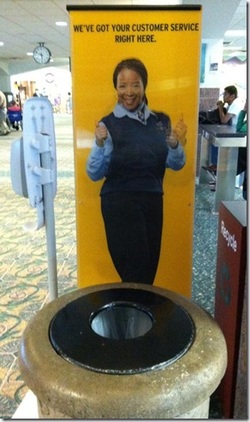
Brand Placement is Key 11/12/2011
The placement of your branding is just as important as the design. Take a look at the example below to see that the old adage rings true even with branding, "location, location, location." Add Comment Building Brand Loyalty 10/29/2011
Being in the service industry myself I know all too well how difficult it can be to satisfy every customer, every time. When consumers are loyal to a company’s brand they are voting with their heart not just with their head. They feel strongly enough that the company will take care of them if something happens that they often will stay loyal to the brand even at a higher price. The consumer these days has a plethora of options at their disposal that it’s even more important than ever for companies to ensure to continue to focus on building brand loyalty each and every day. Studies show the total cost of securing a new customer is far more expensive than having a repeat customer so companies that build brand loyalty also often have an advantage to their bottom line. Another advantage of brand loyalty is the consumer will usually be more than willing to give referrals to their friends and family which helps these companies continue to expand their customer base. As a consumer though, it’s not which company will never make a mistake but rather how the company responds to the mistake that makes all the difference for me. I recently was in the position of needing to buy a new set of tires for my car and given how insanely expensive tires are these days, you can imagine that I did my due diligence on getting price quotes from different tire centers. Truth be told I have been a loyal Les Schwab for many years and in the back of my mind, I knew I would probably purchase from them this time. However, they are not the lowest cost so I wanted to keep them honest by checking out their competitors. Even more importantly I have always had good service with Les Schwab and didn’t know what kind of service or lack thereof I may receive from their competitors. I decided to go with my gut and go with brand that I have been loyal to over the years. I received a competitive price and sat down in their waiting room to get some work done while I waited. I was glad to see the serviceman approach me in anticipation of telling me my vehicle was all ready to go. However, instead what I heard was the following “I apologize Mr. Schneider we have a new employee working today and he accidentally put the wrong size tires on your car. I will get “all hands on deck” and have it done for you in the next 20 minutes and again I am sorry about the mix up.” As I was paying the cashier, he had heard about the little snafu and told me not to worry, he would take care of me. It really wasn’t that big of an inconvenience as I was not running late but I appreciated the fact that he wanted to make sure I was completely satisfied and would return again. He did just that by giving me an additional discount of $60 to make up for this error. To be honest, I wasn’t sure what to expect but all I know is that not only did I feel satisfied but I realized that I received another confirmation of why I am loyal to the Les Schwab brand. What are you doing today to build brand loyalty with your customers? What’s Their Egg? 07/04/2011
For those of you who wondered whether you clicked on the right web site or if I have lost my mind; no, this is not a post on cooking. Rather, this is part of a marketing theory that author Francis Cole Jones refers to as “The Duncan Hines Cake Mike Marketing Theory.” You see when Duncan Hines was first putting their café mix together, the decision was made by their marketing department to have the egg put in at home by the customer, rather than putting a powdered egg in the box. At first glance, you might think this decision had more to do with how the cake might taste or for convenience sake but if you take a closer look, you will see the true reason they made this decision. Duncan Hines realized that by having the customer put the egg in at home, their customers are taking ownership of making a cake by simply being able to say they baked the cake. This lead their customers to truly connect to their cake mix instead of simply saying they bought the mix. Having your customers take ownership of your product or service makes them feel better about your idea or solution. You can bet that if your product or service makes your customers feel better, they will buy from you rather than your competition more often. Having customer connect to your brand is an important marketing strategy but having your customers feel better about your products is the true icing on the cake. (Sorry, I couldn’t resist the cake reference) The next time you are marketing a new product or working on how you can better position your products or services in the market ask yourself this, “what’s their egg?” Is Your Telephone a Branding Device? 02/21/2011
In this highly digital world we live and do business in, it can seem like the telephone and its primary function have become archaic. Some say that texting, instant messages and emails are easier and more productive. While you can maintain and expand your brand to some degree through these channels, you miss the personal interaction that a conversation over the phone can offer. A customer calling into your customer service department is not just an opportunity to answer a concern or respond to a concern. Rather it’s an opportunity to expand your brand by having a captive conversation with your customer for a short block of time. Instead of looking at this as simply a time answer their questions or hear their concern, it’s a great opportunity to execute and build a stronger brand. Remember, you have your customer’s undivided attention for 5-10 minutes. You can choose to merely satisfy their request or use this time to create a loyal customer and even more importantly, a future referral. Many customer service departments utilize a customized script for when a customer calls in with a request, complaint or simply a question. These are great tools for new employees and specifically for new and recurrent training purposes. I wonder though how often the company brand is mentioned in these customized scripts? What better way to reinforce your brand that with your front line employees. These are the folks in the trenches that often deal with the emotional customers who are not usually calling to tell you how much they love your company or your products. They are not meant to be just a firefighter putting out the random hot spots but rather a vehicle to delivery your brand to every customer they come into contact with. Zappos is a great example of a company that totally gets this concept and has been extremely successful due in large part to the fact that their employees not only understand but live out their brand every day. They use the interactions with their customers over the phone as an opportunity to “Wow” them with superior service. They actually want their customer to call them because they understand that each time is an opportunity to strengthen the brand and win the customer for life. One way they motivate their customers to call is by putting their customer service phone number on the top of each web page. Are you using your telephone to merely interact with your customers or to build a stronger brand? Brand Awareness 04/11/2010
Brand is more than image or logo. It is more than our tag line or how we would describe our company in an elevator speech. Perhaps, many of us have not taken the time to decipher the difference between what our company’s brand looks like through the eyes of our customers verses what we, as employees, believe it to represent. Founder of Red Zone Marketing, Maribeth Kuzmeski reminds us that “brand is how someone else describes you, your employees and your products…brand exists whether you like it or not, but you do have the power to control it.” Simply, brand is what people say about you. When we contemplate brand, we primarily think in terms of our external customers, those that we extend our service and/or products. How often, however, do we over look our internal customers, our employees, and ask ourselves if they understand what our company represents? If our brand is what others say about us, what is more important than making sure our front line employees understand who we are? Though we know our employees are an extension of our company and understand the impact they regularly have on our customer, we often overlook what message they may be sending about our brand. It is important to recognize their value on our brand. It is equally important to realize that internal processes and procedures affect our frontline employees, which in turn, affect our brand. The Undercover Boss, on CBS, highlights a different CEO of a major US company each week, going “undercover” in his/her company to work various frontline jobs. The goal is to see the inner workings of his or her own company, to experience firsthand the various jobs within the company; seeing if the policies and procedures they created are being followed and what impact they have on the employees. This also gives them a sense of what the employees know and believe about the brand, which is what is extended to the customers. Each week the featured CEO has an eye opening experience about how their front line employees feel about the company and in turn, their brand. In today’s economy, companies are fighting for every dollar, which has caused us to look at how our brand is perceived by our customers, both internal and external. It is of utmost importance that all employees, especially new employees, are trained to understand the role they play in the overall brand. All employees that interact with customers need to understand they are responsible for building or tearing down brand trust and that each interaction with the customer reinforces the brand one way or another. It is up to the management and department heads throughout the company to continually reinforce this as well as company updates on a regular basis to all employees, making certain that every employee correctly understands and protects the brand. Do your employees know and understand your brand? Do you know what others say about your brand? | ArchivesDecember 2011 CategoriesAll |

RSS Feed